


CATCH A THIEF UK | NATIONAL VEHICLE CRIME & FUEL THEFT PREVENTION

STOLEN NUMBER PLATES: WHAT UK DRIVERS MUST DO TO PROTECT THEMSELVES FROM CRIMINALS
How to report stolen registration plates, protect yourself from fraudulent fines and police stops, and how ANPR technology is helping petrol stations tackle fuel theft across the United Kingdom.
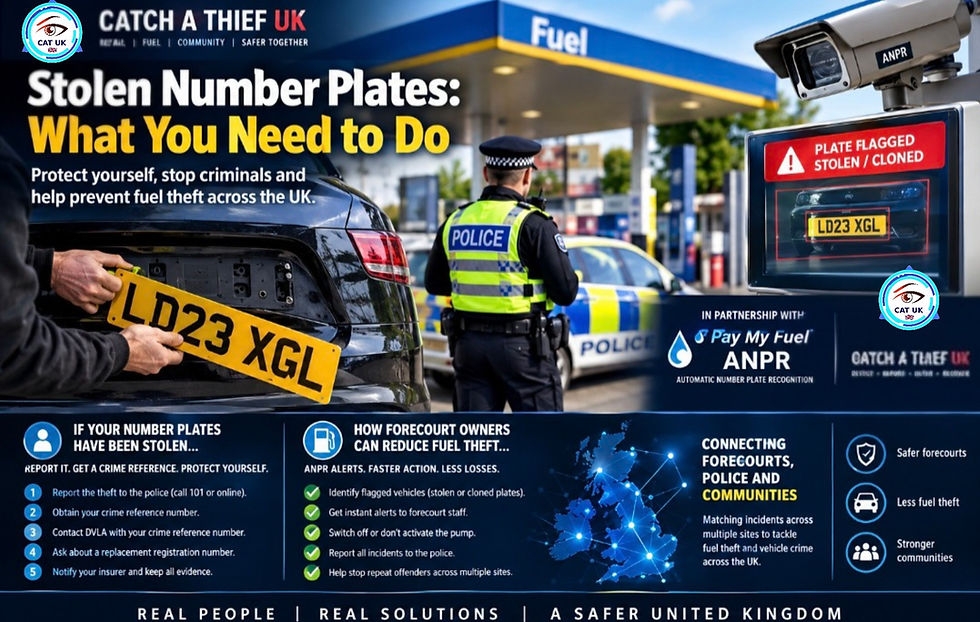
The theft of vehicle registration plates is a serious concern for motorists across the United Kingdom. Criminals can use stolen number plates, or cloned registration numbers, to disguise the identity of vehicles involved in fuel theft, driving offences and other criminal activity.
For the innocent vehicle owner, discovering that their number plates have been stolen can be the beginning of a frustrating experience. A stolen registration number can be associated with offences the genuine vehicle owner had absolutely nothing to do with, potentially resulting in police enquiries, penalty notices, fines and the inconvenience of being stopped by police.
At Catch a Thief UK, we work alongside our partners to help retailers, police and the public tackle vehicle-related crime, including fuel theft and the criminal use of cloned or stolen registration plates.
This educational guide explains what motorists should do if their number plates are stolen, how to protect themselves from criminal misuse, and what petrol station owners and operators can do to help prevent criminals from driving away without paying for fuel.
NUMBER PLATE THEFT: WHAT EVERY MOTORIST NEEDS TO KNOW
A vehicle's registration plates are a visible part of its identity. When criminals steal or copy them, they can use the registration number to make another vehicle appear legitimate.
There are two related but different types of crime:
STOLEN NUMBER PLATES
Criminals physically remove the registration plates from a vehicle and fit them to another vehicle, often to avoid identification by police or ANPR cameras.
CLONED NUMBER PLATES
Criminals copy the registration number of a genuine vehicle and display it on another vehicle, often of a similar make, model and colour, to disguise its true identity.
Both can lead to innocent motorists being wrongly associated with offences committed by someone else.
For example, a criminal could use a stolen or cloned registration plate to drive away from a petrol station without paying for fuel. The vehicle's registration may then be recorded by CCTV or ANPR systems, and the registered keeper of the genuine vehicle could subsequently receive correspondence relating to an incident they know nothing about.
The important message is this: if your number plates have been stolen, or you suspect your vehicle's registration has been cloned, report it promptly and keep a record of everything.
WHAT TO DO IMMEDIATELY IF YOUR NUMBER PLATES HAVE BEEN STOLEN
If you discover that your vehicle's registration plates have been stolen, taking the appropriate steps promptly can help protect you from potential criminal misuse.
STEP 1: REPORT THE THEFT TO THE POLICE
Contact your local police force. In England, Wales and Scotland, you can normally report a non-emergency theft by calling 101 or using your police force's official online reporting service.
If a crime is happening now or there is an immediate danger, call 999.
Explain that your vehicle's registration plates have been stolen, and provide the vehicle registration, make, model, colour, location and approximate time of the theft.
STEP 2: OBTAIN AND KEEP YOUR CRIME REFERENCE NUMBER
Ask the police for the crime reference number and keep it somewhere safe.
This is an important record that allows you to demonstrate that you reported the theft. Keep a copy of the police report and any photographs of the vehicle showing the missing plates.
STEP 3: CONTACT DVLA AND EXPLAIN THE CIRCUMSTANCES
Contact the Driver and Vehicle Licensing Agency (DVLA) and explain that your registration plates have been stolen and that a police report has been made.
Give DVLA your crime reference number and ask what action can be taken to protect the vehicle record and whether a replacement registration number is appropriate in your circumstances.
Do not assume that a police report automatically changes your registration number.
STEP 4: ASK ABOUT A REPLACEMENT REGISTRATION
Where the stolen registration is at risk of being used by criminals, ask DVLA whether it can issue a replacement registration number.
A change of registration is not automatically granted simply because plates have been stolen. DVLA will need to consider the individual circumstances and confirm what procedure applies.
STEP 5: NOTIFY YOUR INSURER AND RETAIN YOUR EVIDENCE
Inform your motor insurer about the theft and any registration change.
Keep copies of police reports, correspondence, photographs, receipts and any notices or fines that arrive in connection with the stolen registration.
Official guidance is available at:
Getting number plates made up: GOV.UK
Contact DVLA
DOES DVLA CHANGE A STOLEN REGISTRATION NUMBER FOR FREE?
This is an important point for motorists.
There is a difference between replacing a missing number plate and changing the vehicle's actual registration number.
Replacing stolen plates means the vehicle keeps its existing registration. A registered number plate supplier makes replacement plates.
Changing the registration means DVLA must authorise a new registration number and update the vehicle record.
Buying replacement plates is separate from changing the registration. The motorist normally pays the supplier for the physical plates.
IS THE DVLA REGISTRATION CHANGE FREE?
DVLA's publicly available guidance does not establish a universal entitlement to a free replacement registration number following number plate theft. The process and any applicable fee must be confirmed directly with DVLA for the individual case.
Do not confuse this with the cost of making replacement plates, which is separate. The motorist should expect to pay a registered number plate supplier for the physical plates.
GOV.UK states that number plates must be obtained from a registered number plate supplier, which must check the customer's identity and entitlement to use the registration number.
Motorists should always obtain DVLA's authorisation before changing the registration displayed on their vehicle.
WHY THE CORRECT REGISTRATION MATTERS
If DVLA approves a new registration, motorists should ensure that their vehicle displays the authorised plates before driving, and that the vehicle's insurance and other relevant records are updated.
A replacement registration can help distinguish the genuine vehicle from a criminal vehicle continuing to use the stolen registration. However, it is important to obtain DVLA's authorisation rather than simply choosing a different number or buying plates displaying a number that has not been assigned to the vehicle.
WHY VICTIMS COULD BE STOPPED BY POLICE OR RECEIVE FINES
When a stolen or cloned registration number is used by a criminal, the genuine vehicle's registration may be recorded in connection with offences that the owner did not commit.
These can include:
* Fuel theft and driving away without payment.
* Speeding offences and other road traffic violations.
* Parking and congestion charge offences.
* Vehicles associated with suspected criminal activity.
A police officer or ANPR system may identify the registration as linked to a vehicle of interest. If the registration appears on a vehicle that matches the details of a stolen or cloned registration, the genuine keeper could face additional enquiries.
This does not mean that the innocent motorist is guilty of an offence. It means that the vehicle's identity may need to be checked.
WHAT SHOULD YOU DO IF YOU RECEIVE A FINE OR NOTICE FOR AN OFFENCE YOU DID NOT COMMIT?
* Do not ignore the correspondence.
* Contact the organisation that issued the notice and explain that your registration has been stolen or cloned.
* Provide the crime reference number and supporting evidence, such as photographs, receipts, CCTV or evidence showing where your vehicle was at the time.
* Keep copies of all correspondence and follow the instructions and deadlines for challenging the notice.
The DVLA's published guidance on cloned vehicles advises motorists to contact the police, return fines or correspondence to the issuing authorities with supporting evidence, and notify DVLA with their crime reference number.
A prompt report and a clear record of the incident can help establish that the genuine vehicle owner is a victim rather than the person responsible.
WHAT CAN UK PETROL STATION OWNERS DO TO PREVENT FUEL THEFT?
Fuel theft remains a significant challenge for forecourt operators. Criminals can exploit busy forecourts, stolen registration plates, cloned number plates and vehicles with false or concealed identities to avoid detection.
Traditional CCTV can provide valuable evidence after an incident. However, by the time staff review footage and discover that a vehicle has left without paying, the fuel has already been taken.
This is where Automatic Number Plate Recognition (ANPR) technology can provide an additional layer of protection.
PAY MY FUEL ANPR: HELPING FORECOURTS IDENTIFY FLAGGED VEHICLES
Catch a Thief UK's partner, Pay My Fuel, provides an ANPR-based approach designed to help participating forecourts identify vehicles associated with fuel theft and registration-related risks.
The Pay My Fuel ANPR database can alert participating forecourt staff when a vehicle's registration is flagged within the system, including registrations associated with suspected theft or cloning.
Depending on the site's equipment and operational procedures, this information can give staff the opportunity to take action before fuel is dispensed or before a suspected offender leaves the site.
HOW ANPR CAN HELP PROTECT A FORECOURT
1. VEHICLE ENTERS THE FORECOURT
ANPR cameras capture the vehicle's registration number as it enters or approaches the fuel pumps.
2. REGISTRATION CHECKED AGAINST THE DATABASE
The captured registration is checked against relevant records in the Pay My Fuel ANPR system.
3. AN ALERT IS SENT TO FORECOURT STAFF
Where a registration is flagged and the site's system is configured to do so, staff can receive an alert to investigate before authorising fuel.
4. STAFF CAN TAKE PREVENTATIVE ACTION
Staff may use the alert to delay or withhold pump activation, follow site procedures and contact the appropriate authorities where necessary.
The key benefit is the opportunity to act before a potential fuel theft takes place, rather than relying solely on CCTV footage after the event.
An ANPR alert is an indication that a vehicle requires further checks. It is not proof that the driver is guilty of a crime. Staff should follow their training, the site's procedures and applicable law, and should not confront suspected offenders where doing so would put anyone at risk.
WHY FORECOURTS SHOULD TAKE NUMBER PLATE CLONING SERIOUSLY
Criminals who use cloned plates can create problems for multiple petrol stations. A registration number involved in one incident may subsequently appear at another forecourt, potentially under a different vehicle identity.
By using shared information and identifying repeat registrations or patterns across participating sites, forecourt operators can improve their understanding of suspected offending and take more informed preventative action.
For independent petrol stations, this can provide an additional layer of security without relying exclusively on staff manually checking every vehicle.
Forecourt owners and operators interested in the system can contact Catch a Thief UK or Pay My Fuel to discuss participation, system requirements and site procedures.
6. HOW CATCH A THIEF UK SUPPORTS FORECOURTS AND POLICE
Catch a Thief UK works with Pay My Fuel to support fuel theft prevention, incident reporting and the identification of repeat offending across the United Kingdom.
Our work goes beyond recording an individual incident. By bringing together information from participating forecourts, we can help identify connections between incidents that might otherwise be treated as isolated events.
DETECT – REPORT – DETER – RECOVER
DETECT
Support forecourts in identifying suspected fuel theft, using ANPR information, CCTV evidence and incident records.
REPORT
Catch a Thief UK reports suspected fuel theft incidents to the police, providing relevant information and evidence to assist investigations.
DETER
By matching incident information across multiple participating sites, we help identify repeat activity and patterns that can inform prevention measures.
RECOVER
Working alongside Pay My Fuel, we support the civil recovery process for eligible unpaid fuel incidents, helping participating retailers address financial losses.
CONNECTING THE DOTS ACROSS THE UK
One of the challenges facing forecourt operators is that a vehicle involved in suspected fuel theft at one location may subsequently appear at another site, sometimes in a different police force area.
Catch a Thief UK's work includes matching incident information across multiple forecourts and reporting suspected incidents to the relevant police services.
This approach can help identify:
* Vehicles and registration numbers appearing in multiple reported incidents.
* Repeat patterns of suspected fuel theft across different locations.
* Links between incidents that may assist police enquiries.
* Information that participating forecourts can use to strengthen their prevention procedures.
The objective is to help bridge the gap between individual retailers, forecourt operators and law enforcement, while supporting the lawful sharing of relevant information.
Information must be handled in accordance with applicable data protection requirements, and any suspected links or registration matches should be assessed alongside the available evidence.
7. A MESSAGE TO THE PUBLIC AND FORECOURT OPERATORS
Vehicle registration theft and cloning are not simply problems for the person whose number plates have been taken. They can affect innocent motorists, petrol station operators, police investigations and other road users.
For motorists, the message is straightforward: if your plates are stolen, report the theft to the police, obtain a crime reference number, contact DVLA and keep a clear record of the incident. If you suspect your registration has been cloned, do not ignore fines or official correspondence.
For petrol station owners and operators, preventative technology and effective reporting procedures can help reduce opportunities for criminals to exploit the forecourt.
ANPR systems, when combined with trained staff, appropriate checks, CCTV and prompt reporting, can help forecourts respond to potential threats before losses occur.
Catch a Thief UK and Pay My Fuel are working together to support a more connected approach to fuel theft prevention and recovery across the United Kingdom.
Forecourt operators interested in Pay My Fuel ANPR and fuel theft prevention can contact Catch a Thief UK to discuss how the partnership may support their site.
USEFUL CONTACTS AND OFFICIAL GUIDANCE
POLICE
Find your local police force and reporting options:
Call 101 for non-emergency matters in England, Wales and Scotland, or 999 in an emergency.
DVLA
For guidance about registration changes, stolen plates and vehicle records.
CATCH A THIEF UK

EDITORIAL NOTE
This article is for educational purposes and is not legal advice. DVLA procedures and eligibility for a replacement registration should be confirmed directly with DVLA. Information about the Pay My Fuel ANPR partnership and Catch a Thief UK's reporting activities is based on the partnership and operational details supplied for this article.
CATCH A THIEF UK
DETECT • REPORT • DETER • RECOVER
Real People. Real Solutions. A Safer United Kingdom.


Comments