


Crime, Consequences and the Strain on Policing: Why the UK Is Reaching a Tipping Point

Across the United Kingdom, many communities are reporting the same experience: rising crime, repeat offenders, declining high streets, and a growing sense that policing is stretched thin. Shoplifting, antisocial behaviour, drug-related offending and low-level violence are becoming normalised in places that were once stable and well ordered.
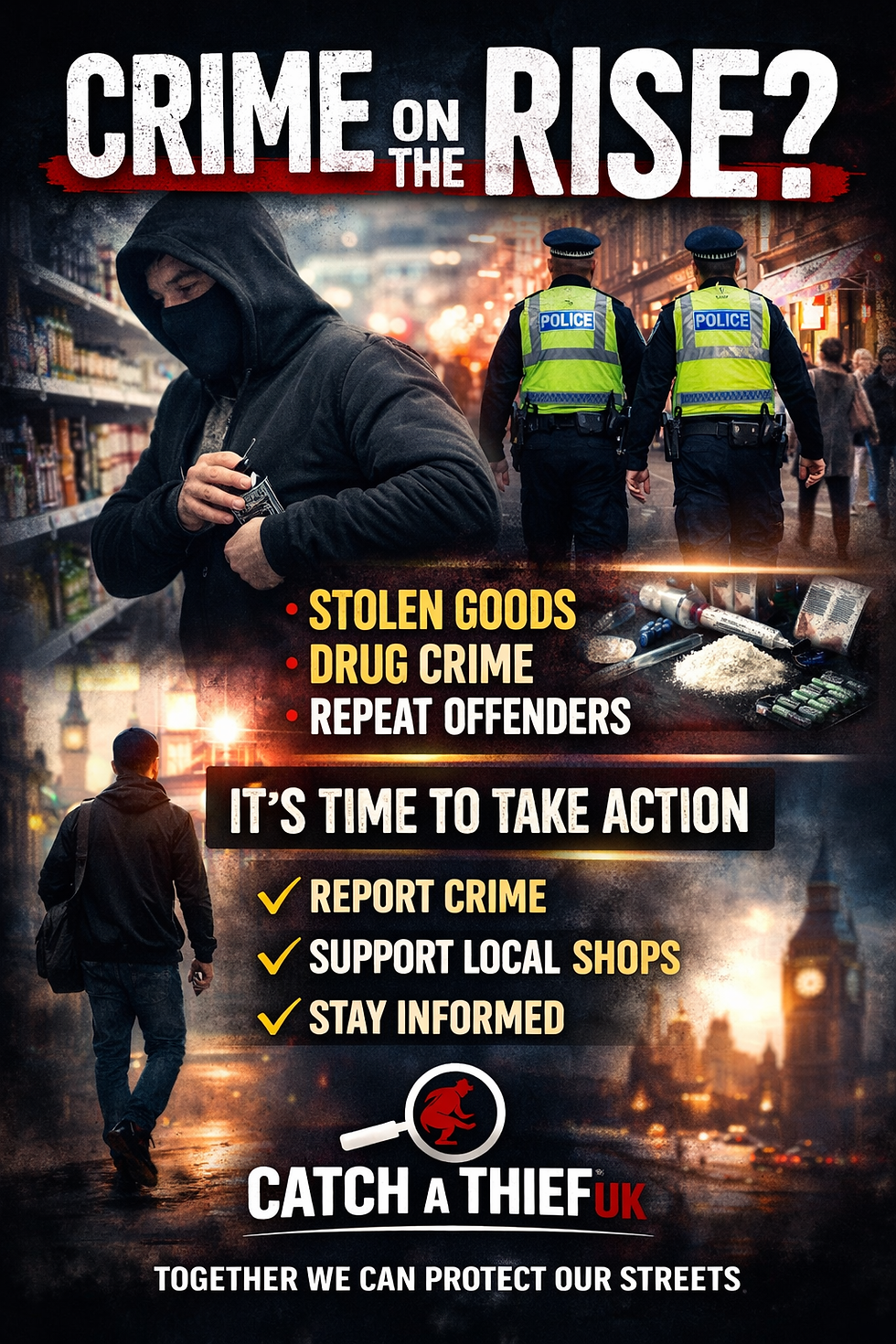
This is not simply a matter of perception. It is the result of multiple systems under strain at the same time, policing, justice, health, and social support, no longer working together as they once did.
Understanding the problem clearly is the first step towards fixing it.
A Changing Crime Landscape
Modern crime in the UK has changed significantly over the past two decades. Much offending is now:
Repetitive rather than opportunistic
Linked to organised criminal networks
Driven by addiction and exploitation
Low-risk and high-reward for offenders
Retail theft, for example, is no longer isolated or impulsive. In many cases it is part of a wider criminal economy, funding illegal drugs and organised activity. Many prolific offenders are already known to police, retailers and local services, yet continue to offend repeatedly.
Why Policing Feels Absent, Even When Officers Are Working Flat Out
Contrary to popular belief, the issue is not that police officers are doing nothing. The reality is that they are being pulled in too many directions at once.
Frontline officers now spend large amounts of time dealing with:
Mental health crises
Domestic safeguarding
Missing persons
Terrorism
Serious Violence
Prisoner supervision due to court delays
Administrative and evidential paperwork
This leaves fewer officers available for visible patrols and proactive policing, which are the very things that reassure the public and deter crime.
At the same time, officers operate under intense scrutiny and risk of complaint, making proactive enforcement more cautious and defensive.
The Collapse of Consequences
One of the most significant drivers of rising crime is the loss of certainty around consequences.
Many offenders now believe:
They will not be pursued for low-level offences
Charges are unlikely to follow
Court cases will take months or years
Sentences will be minimal or unenforced
This belief changes behaviour: When offenders expect no meaningful outcome, crime escalates rapidly, especially repeat offending.
It is not severity that deters crime most effectively, but certainty and speed.
Illegal Drugs: A Crime Multiplier
Illegal drugs sit at the centre of much volume crime in the UK.
Drug dependency:
Drives repeat shoplifting and burglary
Feeds organised crime networks
Exploits vulnerable individuals
Fuels violence and intimidation
A single dependent offender can commit dozens, sometimes hundreds, of offences a year to fund addiction. Low-level crime becomes the financial engine of larger criminal enterprises.
Enforcement that targets users without disrupting supply, or supply without addressing dependency, fails to break the cycle.
Mental Health and the Criminal Justice Gap
Mental illness itself does not cause crime. However, system failure does.
Police have increasingly become the default responders to mental health crises due to:
Insufficient crisis services
Lack of secure treatment facilities
Poor coordination between agencies
As a result, vulnerable individuals are repeatedly drawn into the criminal justice system instead of receiving sustained care. This benefits no one, not the individual, not the police, and not the community.
Poverty and Environmental Decline
Poverty alone does not automatically lead to crime, but concentrated deprivation combined with disorder creates fertile ground for it.
When communities experience:
Closed shops and empty high streets
Reduced services
Poor lighting and infrastructure
Little visible authority
A message is sent that order has withdrawn. Criminal activity follows opportunity and absence, not just intent.
In these conditions, criminal economies often replace legitimate ones.
A Fragmented System
Perhaps the most critical issue is that no single body owns the whole problem.
Police are expected to manage crime, health crises and social breakdown
Health services struggle to contain high-risk individuals
Courts and the CPS face severe backlogs
Social services are overwhelmed
Communities lose confidence and disengage
When systems fail to align, offenders fall through gaps, repeatedly.
What Actually Works
Evidence from the UK and abroad shows that crime reduces when authority, care and consequence are integrated.
Key solutions include:
Certainty of consequences, especially for repeat offenders
Fast-track justice for volume crime
Dedicated crime units focused on shoplifting, burglary and antisocial behaviour
Compulsory treatment linked to offending, not optional support
Protected, visible patrols in town centres and retail hubs
Reduced bureaucracy, allowing officers to spend more time policing
Proper mental health crisis pathways, not police cells
Honest public communication about priorities and limits
Compassion without boundaries creates disorder.
Boundaries without compassion create harm.
Both are required.
A Decision Point for the UK
The UK is not beyond repair, but it is at a critical decision point.
If low-level crime continues to be tolerated, it becomes embedded. History shows that delayed action often leads to harsher measures later, with less public consent and greater damage.
Restoring order early, fairly, visibly and consistently, is always the better path.
Why This Matters
Crime does not exist in isolation. It affects:
Local businesses
Community trust
Economic stability
Public safety
Social cohesion
When people believe the rules no longer apply equally, confidence in institutions erodes.
Rebuilding that confidence starts with acknowledging the full picture, and acting on it.
Take Action Today
Crime thrives when communities stay silent. You have the power to make a difference:
Report suspicious activity: Use local police non-emergency numbers or Crimestoppers to pass on information safely.
Support local businesses: Shop locally and be aware of safety measures in your area.
Engage with your community: Neighbours who communicate and look out for one another reduce opportunities for crime.
Stay informed: Follow credible news sources like Catch a Thief UK to understand trends and protective measures.
Together, awareness, vigilance, and action create safer streets for everyone. Don’t wait, your voice matters. Report, support, and stay engaged.
Catch a Thief UK will continue to report on crime trends, court outcomes and community impact, giving a voice to victims, retailers and the public, and encouraging informed discussion about solutions that work.


Comments