


CATCH A THIEF UK NATIONAL RETAIL CRIME REPORT

Shoplifting in Britain: The scale of the problem, the impact on businesses and how retailers can fight back
Published by Catch a Thief UK
INTRODUCTION: THE GROWING CHALLENGE OF RETAIL CRIME
Shoplifting continues to affect retailers, employees, customers and communities across Britain.
From independent convenience stores and family-run businesses to major supermarkets and shopping centres, retailers face ongoing challenges from theft, abuse, intimidation and violence.
The consequences extend far beyond the value of stolen goods. Retail crime can affect business profitability, increase operating costs, undermine staff confidence and contribute to higher prices for consumers.
Catch a Thief UK has been working to help retailers prevent crime, improve reporting and strengthen cooperation between businesses, security professionals and the police.
This National Retail Crime Report examines the available official figures, the impact of shoplifting on British businesses and the practical measures retailers can take to protect their staff, customers and stock.
Our approach is built around four key principles:
DETECT – REPORT – DETER – RECOVER
1. THE SCALE OF SHOPLIFTING IN BRITAIN
Shoplifting remains a significant problem for police forces and retailers across England and Wales.
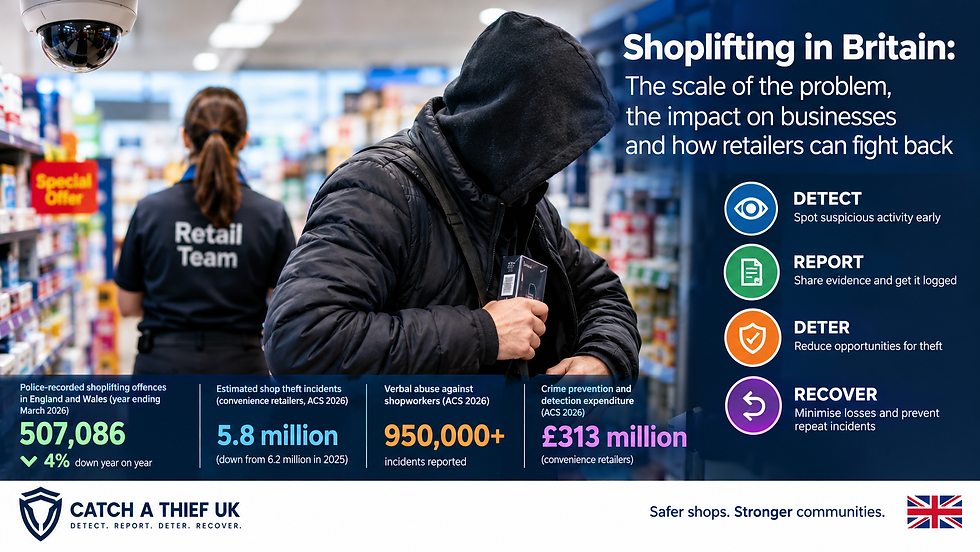
According to the Office for National Statistics (ONS), police recorded 507,086 shoplifting offences in the year ending March 2026, a decrease of 4% compared with the previous year.
These figures represent offences recorded by the police, not necessarily every incident that occurred.
Many incidents are never reported, and not every reported incident results in an identified offender, arrest or prosecution.
The police-recorded figures should therefore be considered alongside independent retail industry research to understand the wider scale of the problem.

Official statistics:
The wider retail crime picture
The Association of Convenience Stores (ACS) has also reported extensive levels of theft and abuse affecting convenience retailers.
Its industry research has highlighted:
* Approximately 5.8 million incidents of shop theft.
* More than 950,000 incidents of verbal abuse against convenience store colleagues.
* £313 million invested by convenience retailers in crime prevention.
* 64% of convenience retailers reporting that crime had increased.
These industry figures provide a broader picture of the experiences of retailers, including incidents that may not appear in police-recorded statistics.
The ACS figures relate to the convenience retail sector and its own research, rather than every retailer across the UK. They should not be directly added to ONS police-recorded figures because the measures, reporting periods and methodologies differ.
Official industry source:
2. THE IMPACT OF SHOPLIFTING ON BUSINESSES
Shoplifting is not a victimless crime.
Every stolen product represents a financial loss to a business. When theft becomes persistent, the cumulative effect can be substantial.
For independent retailers and smaller businesses operating on tight margins, repeated losses can affect their ability to remain competitive and sustainable.
Financial losses and rising operating costs
Retailers face a combination of direct and indirect costs associated with crime.
These include:
* The replacement cost of stolen stock.
* Increased expenditure on CCTV, security equipment and loss prevention.
* Additional staff training and security personnel.
* Repairs to damaged property, display cabinets and security equipment.
* Time spent reviewing CCTV footage, preparing evidence and reporting incidents.
* Administrative costs associated with investigations and civil recovery.
Businesses may also experience higher insurance costs and restrictions on the products they can safely display.
Some retailers respond by placing everyday products behind security screens or removing certain items from open display.
This can affect the shopping experience for genuine customers.
Ultimately, the cost of retail crime can contribute to higher operating costs throughout the retail sector.
The impact on employees
Retail workers are increasingly expected to manage difficult and sometimes dangerous situations while continuing to serve customers.
Verbal abuse, threats, intimidation and physical assaults can have a serious effect on employees.
No member of retail staff should be expected to put themselves in danger to protect stock.
Retailers must ensure that staff receive appropriate training, understand their responsibilities and know when to withdraw from a situation and seek assistance.
The safety of employees and customers must always take priority over the recovery of merchandise.
3. THE LAW: SHOPLIFTING AND RETAIL THEFT IN ENGLAND AND WALES
Shoplifting is a criminal offence under the Theft Act 1968.
Section 1 of the Act defines theft as the dishonest appropriation of property belonging to another with the intention of permanently depriving the other of it.
Section 7 provides for the maximum penalty for theft.
Official legislation:
The £200 threshold and changes to the law
The legal position surrounding low-value shop theft has been subject to legislative change.
The previous special treatment of shop theft involving goods worth £200 or less was introduced by the Anti-social Behaviour, Crime and Policing Act 2014.
The Crime and Policing Bill and its subsequent legislative provisions have sought to address the treatment of shop theft and strengthen the response to retail crime.
However, the passage of legislation and the commencement of individual provisions are not necessarily the same thing.
The commencement regulations, rather than the announcement of a Bill or the date it receives Royal Assent, determine when particular provisions become operational.
The commencement instrument, SI 2026/960, does not list sections 45–47 as commencing on 29 September 2026. Their operational status must therefore be checked against the applicable legislation and commencement provisions before making a definitive claim about their effect.
For retailers, the important practical point is that low-value shoplifting should still be recorded and reported. The value of stolen goods does not mean that retailers should ignore an incident or assume that the police cannot take action.
Official sources:
Retailers should consult the current legislation and relevant police guidance for the legal position applicable to a particular incident.
4. WHY REPORTING EVERY INCIDENT MATTERS
One of the most important steps in tackling retail crime is ensuring that incidents are properly documented and reported.
When thefts go unreported, the police and other relevant agencies may not have a complete picture of offending patterns, repeat incidents or the scale of losses affecting a particular area.
Reporting can help establish links between incidents, identify repeat offending and provide evidence to support investigations.
Retailers should establish clear procedures for reporting theft, threats, violence and criminal damage.
What retailers should record
Where it is safe and appropriate to do so, retailers should record:
* The date and time of the incident.
* The location and business premises involved.
* A description of the incident and the goods taken.
* The value of the goods, where known.
* Descriptions of the suspect and any relevant witnesses.
* CCTV footage and other available evidence.
* Vehicle registration details, where lawfully obtained.
* The police crime reference number, when provided.
CCTV footage should be preserved promptly to reduce the risk of important evidence being lost through automatic recording-system overwriting.
Retailers should follow police instructions on submitting evidence and ensure that personal information is handled in accordance with applicable data protection requirements.
5. HOW RETAILERS CAN FIGHT BACK
There is no single security measure that can prevent every theft.
A coordinated approach combining staff awareness, physical security, technology, effective reporting and cooperation with police can help retailers reduce opportunities for offending.
Catch a Thief UK encourages retailers to adopt a structured approach to crime prevention.
DETECT: Identify suspicious activity early
Early detection can help retailers recognise potential theft before goods leave the premises.
Measures include:
* Professionally positioned CCTV systems.
* Clear sightlines throughout the store.
* Effective stock control and regular inventory checks.
* Electronic article surveillance and appropriate product security.
* Staff training in recognising suspicious behaviour.
* Lawfully deployed AI-assisted video analytics.
AI-assisted CCTV systems can help identify patterns of behaviour that may warrant staff attention.
Such systems should support trained personnel rather than replace human judgement. Alerts should be assessed in context, and retailers should avoid treating an automated alert as proof that a crime has occurred.
REPORT: Create an effective reporting process
Retailers should ensure that employees know how to report incidents and preserve evidence.
A consistent reporting procedure can help businesses identify repeat incidents, maintain accurate records and provide information to police.
Where multiple stores or sites are affected, sharing relevant incident information lawfully can help establish patterns that might otherwise remain unidentified.
Retailers should also maintain clear escalation procedures for violent or threatening situations.
Staff should contact the police when appropriate and must not place themselves or customers at unnecessary risk.
DETER: Make offending more difficult
Visible and effective security measures can help reduce opportunities for theft.
These may include:
* Visible CCTV and appropriate signage.
* Trained security personnel.
* Secure product displays for high-risk merchandise.
* Improved lighting and store layout.
* Staff presence and customer engagement.
* Appropriate access controls and electronic security systems.
Retailers should review their security arrangements regularly and adapt them to changing risks.
A security plan that works for one premises may not be suitable for another.
The size of the store, its location, trading hours, product range and previous incidents should all be considered.
RECOVER: Pursue lawful recovery of losses
Where goods have been stolen, retailers may have options to pursue the recovery of losses through appropriate legal and civil processes.
Civil recovery is separate from criminal prosecution.
Retailers should ensure that any recovery process is lawful, proportionate and supported by appropriate evidence.
They should not make threats, impose unlawful charges or misrepresent their legal powers.
Where a specialist recovery provider is involved, businesses should establish clear contractual arrangements and ensure that personal data is processed lawfully.
Catch a Thief UK supports a joined-up approach to prevention, reporting and recovery, helping retailers understand the options available to them following an incident.
6. CCTV, ARTIFICIAL INTELLIGENCE AND THE FUTURE OF RETAIL SECURITY
Technology is playing an increasingly important role in retail crime prevention.
Traditional CCTV remains valuable for monitoring premises, reviewing incidents and providing evidence.
Newer AI-assisted systems can analyse video feeds and alert staff to behaviour that may require further attention.
These technologies can help retailers make better use of existing security infrastructure, particularly where staff cannot continuously monitor every camera.
However, technology must be implemented responsibly.
Data protection and privacy
CCTV and AI systems may process personal data and, depending on the technology used, may involve additional privacy considerations.
Retailers must consider their obligations under the UK General Data Protection Regulation and the Data Protection Act 2018.
This includes ensuring that surveillance is necessary, proportionate and supported by an appropriate lawful basis.
Businesses should provide appropriate privacy information, restrict access to footage, establish retention periods and ensure that any sharing of information is lawful.
The use of facial recognition or biometric technology requires particularly careful consideration.
Retailers should not assume that the use of security technology automatically makes the collection or sharing of personal data lawful.
Official guidance:
7. WORKING TOGETHER: RETAILERS, POLICE AND SECURITY PROFESSIONALS
Retail crime cannot be addressed by individual businesses working in isolation.
Effective cooperation between retailers, police forces, local authorities, shopping centre management and professional security organisations can help improve the reporting and prevention of crime.
Sharing relevant information can help identify repeat offending and provide a clearer understanding of local crime patterns.
However, information sharing must be conducted through appropriate channels and in compliance with data protection law.
Retailers should establish relationships with their local police neighbourhood teams and understand the reporting arrangements available in their area.
Businesses should also review whether existing retail crime partnerships or local business crime reduction schemes could support their security arrangements.
A coordinated approach can help businesses make better use of available resources and improve the quality of information provided to investigators.
8. THE CATCH A THIEF UK APPROACH
Catch a Thief UK has been working with retailers and security partners to support crime prevention, incident reporting and the responsible use of security technology.
Our work is focused on helping businesses understand the risks they face and identify practical measures to reduce losses.
We believe that effective retail crime prevention requires more than simply reacting after goods have been stolen.
Businesses need appropriate security systems, trained staff, reliable reporting procedures and access to professional support.
Our approach brings together four essential elements:
DETECT. REPORT. DETER. RECOVER.
By combining these principles, retailers can develop a more structured response to theft and associated criminal activity.
Catch a Thief UK also supports greater awareness of retail crime and encourages businesses to report incidents rather than allowing offending to go undocumented.
We recognise that each retailer faces different challenges and that solutions must be proportionate to the individual business.
9. RETAILER CRIME PREVENTION CHECKLIST
Retailers can use the following checklist to review their existing arrangements.
CCTV and security
* CCTV cameras cover relevant areas of the premises.
* Recording equipment is working correctly.
* Footage can be preserved and supplied when required.
* Security systems are reviewed regularly.
* High-risk merchandise receives appropriate protection.
Staff training and safety
* Employees know how to report theft and other incidents.
* Staff understand when to withdraw from a dangerous situation.
* Procedures exist for dealing with threats and violence.
* Employees know how to preserve relevant evidence.
* Staff are not encouraged to physically confront offenders.
Reporting and evidence
* Incidents are recorded consistently.
* Police reports are made where appropriate.
* Crime reference numbers are retained.
* CCTV and witness information are preserved.
* Repeat incidents are reviewed for patterns.
Data protection and compliance
* CCTV signage and privacy information are appropriate.
* Access to recordings is restricted.
* Retention periods are documented.
* Information sharing is lawful and proportionate.
* Security technology is reviewed for privacy and compliance risks.
CONCLUSION: RETAIL CRIME REQUIRES A COORDINATED RESPONSE
Shoplifting and associated retail crime continue to place financial and operational pressure on businesses across Britain.
The available police statistics and retail industry research demonstrate the scale of the challenge, while also highlighting the importance of understanding the differences between recorded offences and wider estimates of retail crime.
For retailers, effective prevention begins with understanding local risks, protecting employees and customers, maintaining accurate records and reporting incidents appropriately.
Security technology can play an important role, but it must be combined with trained staff, responsible procedures and cooperation with relevant authorities.
Catch a Thief UK believes that retailers should have access to practical information and professional support to help them protect their businesses and communities.
Through better detection, consistent reporting, effective deterrence and lawful recovery, retailers can take meaningful steps to address retail crime.
Catch a Thief UK
Retail crime prevention. Security awareness. Protecting businesses and communities.
Website: Catch a Thief UK
Facebook: Catch a Thief UK

Editorial note: This is a clean, reconstructed copy based on the final article's recorded contents and corrections. I could retrieve the article's headline, statistics, legal correction and section details, but not the complete original wording from the other thread. Accordingly, this should not be treated as a guaranteed verbatim reproduction of that earlier version.


Comments